Divine means - delightful or lovely
Decadence means - indulgence
As these words are so different, putting them together creates an oxymoron. Here is a definition of an oxymoron 'a figure of speech by which a locution produces an incongruous, seemingly self-contradictory effect, as in “cruel kindness” or “to make haste slowly.”'.
Therefore to me, Divine Decadence means it is delightful to indulge.
Sunday, 30 November 2014

Colour in Cabaret
I was in a group with Millie and Laila.
We discussed that each character had its own colour theme and focused on 2 characters,
Emcee - we said his colours were white black and red. His hair and make up always seem to compliment his costumes, for example he wears a black suit, white shirt and red bow tie. and his make up is a paler face almost white with red cheeks and lips and a black sleek hairstyle. He also wear black eyelashes to complete the look. I find the Emcee's make up quite creepy as it reminds me of typical clown like make up and also resembles the Joker from the Dark Knight.

We discussed that each character had its own colour theme and focused on 2 characters,
Emcee - we said his colours were white black and red. His hair and make up always seem to compliment his costumes, for example he wears a black suit, white shirt and red bow tie. and his make up is a paler face almost white with red cheeks and lips and a black sleek hairstyle. He also wear black eyelashes to complete the look. I find the Emcee's make up quite creepy as it reminds me of typical clown like make up and also resembles the Joker from the Dark Knight.
Sally Bowles - Sally has a typical make up look that was popular in the 1920 era and a similar colour scheme which was blue/green eyes and red lips. She also has her signature green nails that co ordinate with her eyes. Her performance outfits are always a classy black colour that compliments her hair and huge eyelashes.

Key words
I have chosen 2 key words to describe Frl Kost and they are CHEEKY and ASHAMED.
Cheeky - I have chosen the word cheeky because Christopher Isherwood states Fraulein Kost and another lodger are on intimate terms as in "he tickles her and slaps her bottom; she hits him over the head with a frying pan or a mop". She still then carries on to sleep with random men for money.
Ashamed - I have chosen my other word to be ashamed because I feel Frl Kost tells Frl Schoeder that she eats chocolate to try and believe it herself as she is ashamed that her job is prostitution.
Cheeky - I have chosen the word cheeky because Christopher Isherwood states Fraulein Kost and another lodger are on intimate terms as in "he tickles her and slaps her bottom; she hits him over the head with a frying pan or a mop". She still then carries on to sleep with random men for money.
Ashamed - I have chosen my other word to be ashamed because I feel Frl Kost tells Frl Schoeder that she eats chocolate to try and believe it herself as she is ashamed that her job is prostitution.
Actioning - to beg
I chose my action 'to beg' because Fraulein Kost had to persuade Fraulein Schneider to let her stay in the house as long as she didn't see the prostition happening. Even though Schneider was angry at first, when she realised she would be losing rent from Kost, she agreed to let her stay. I think she acted desperate to make Schneider feel sorry for her.
Again, the analysis above was for the film Cabaret, the one below is for Goodbye to Berlin.
I chose my action 'to lie' because Fraulein Kost does actually lie to Frl Schoeder when she questions her as the gentleman is Japanese and cannot speak German. Frl Kost is clearly on the spot and lies "we play the gramophone together and eat chocolate". I don't know why Frl Schoeder asked her what they did when she secretly knew what she was doing with all the different men.

To portray this in the make-up, I would maybe add some sweat to the forehead and nose to show she would have panicked as Frl Kost would've had to think quickly on the spot. I would've done this by adding some glycerine with cotton wool, as the droplets form perfectly like sweat.
Again, the analysis above was for the film Cabaret, the one below is for Goodbye to Berlin.
I chose my action 'to lie' because Fraulein Kost does actually lie to Frl Schoeder when she questions her as the gentleman is Japanese and cannot speak German. Frl Kost is clearly on the spot and lies "we play the gramophone together and eat chocolate". I don't know why Frl Schoeder asked her what they did when she secretly knew what she was doing with all the different men.
To portray this in the make-up, I would maybe add some sweat to the forehead and nose to show she would have panicked as Frl Kost would've had to think quickly on the spot. I would've done this by adding some glycerine with cotton wool, as the droplets form perfectly like sweat.
When?/where?
Season - I imagine the season to be autumn, I thought this immediately from the front cover of the book as the colours are yellow, oranges and reds. Also, in the opening paragraphs of the book the line "Young men are calling their girls. Standing out in the cold.." This suggests it isn't summer as the evenings would still be warm.

I found this painting by Stefan Kuhn of Berlin in 1925. The trees are autumn leaves and the women still look somewhat classy in their fur coats even though everyone is struggling for money.
I found this painting by Stefan Kuhn of Berlin in 1925. The trees are autumn leaves and the women still look somewhat classy in their fur coats even though everyone is struggling for money.
Fräulein Kost has just led one of her customers to the door. I think this suggests they have just slept together, although she claims that she only ever plays music and eats chocolate. I think she says this so people do not get the wrong impression of her, when she secretly uses prostition to earn her money.
Stairs
The scene I have chosen to focus on is on a staircase in Fraulein Schroeder's flat. It's where Herr Issyvoo meets Frl. Kost for the first time after thinking she is a tightrope worker, only to find out her real profession...


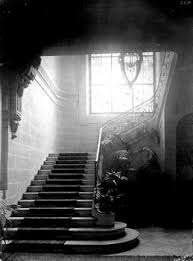
I had an idea of the stairs that the characters would've met on. However, I did some research on 1920's buildings and these are 3 images I chose of staircases that I felt would represent the scene and era nicely. My favourite image is the middle one, especially with the sepia effect I think it looks very old fashioned with the big Grandfather clock.
Act 1 Scene 7 - Cabaret Script/ Goodbye to Berlin
I have chosen my historical character Fraulein Kost from the Cabaret Script from Act One, Scene Seven. I have chosen this scene because I feel sorry for Fraulein Kost, it is extremely sad that women in this time had to use prostitution to keep a roof over their head. I also feel Fraulein Schneider doesn't understand what it is like to struggle in an economic crisis, because she was brought up in a middle class family who were reasonably wealthy.
Fraulein Kost claims the second sailor was her brother, however Fraulein Schneider seems to think differently, and she lets it slide as Fraulein Kost threatens to leave Schneider's home. Schneider agrees for her to stay as long as she doesn't see the Sailors coming to and from her home because she doesn't like the idea of prostitution.

The scene from Goodbye to Berlin as well and I chose the scene where Fraulein Kost is just meeting one of her customers on the stairs and is in complete denial that she is a prostitute. I think she acts this way in front of Herr Issyvoo to make her look sophisticated.
Fraulein Kost claims the second sailor was her brother, however Fraulein Schneider seems to think differently, and she lets it slide as Fraulein Kost threatens to leave Schneider's home. Schneider agrees for her to stay as long as she doesn't see the Sailors coming to and from her home because she doesn't like the idea of prostitution.
The scene from Goodbye to Berlin as well and I chose the scene where Fraulein Kost is just meeting one of her customers on the stairs and is in complete denial that she is a prostitute. I think she acts this way in front of Herr Issyvoo to make her look sophisticated.
Goodbye to Berlin
I read Goodbye to Berlin when we started this project so I could immediately choose my character and start analysing them to create my historical design.

When reading the book, I wanted to choose a character that wasn't so popular because I wanted to use my imagination and research to build up a profile for them. As I was reading, Fraulein Kost stuck out to me because she seemed quite introvert and dishonest with herself. Also, Frl. Kost wasn't in the film very much, so I could create a make up design from my own research without feeling the need to copy the film.
Herr Issyvoo asks about her Japanese customer she replies "we play the gramophone together, you know, and eat chocolates.." Fraulein Kost is clearly lying as Fraulein Schoeder lets Herr Issyvoo know she is a "common prostitute".
Once I had read this part of the book, I instantly knew I wanted to choose Fraulein Kost.
Cabaret film
I had never seen the film Cabaret until I started the unit, however I really enjoyed it. Instead of just watching the film, I try to analyse characters to get a full understanding of their personality. Since starting the course, I have learnt that looking into hair and make up of a character can really help understand their persona.

I love the image above of Liza Minnelli as Sally, especially as it is black and white, I feel she looks a strong independent woman. She is performing, standing tall and proud.
It is good to think about why the designer has created the hair and make up look in that way for example from Cabaret - Sally's green nails.
Sally states "If anyone should ask me why, I'd say 'I think its pretty'." As she has green nails, the make up artist has also tied in a green/blue eyeshadow, which was in fashion around the 1920's.

I didn't know much about the Weimer Berlin era until I started researching, I feel watching Cabaret helped me to get a good overview of what Berlin was like in the 1920's/30's. I like to watch films to see a visual reference to what people looked like and the fashion in those eras.

I chose to include the picture above because it is taken from the real Weimer Berlin Era, it shows women really did put on shows like the ones in Cabaret and the fashion was very similar.
I love the image above of Liza Minnelli as Sally, especially as it is black and white, I feel she looks a strong independent woman. She is performing, standing tall and proud.
It is good to think about why the designer has created the hair and make up look in that way for example from Cabaret - Sally's green nails.
Sally states "If anyone should ask me why, I'd say 'I think its pretty'." As she has green nails, the make up artist has also tied in a green/blue eyeshadow, which was in fashion around the 1920's.

I didn't know much about the Weimer Berlin era until I started researching, I feel watching Cabaret helped me to get a good overview of what Berlin was like in the 1920's/30's. I like to watch films to see a visual reference to what people looked like and the fashion in those eras.
I chose to include the picture above because it is taken from the real Weimer Berlin Era, it shows women really did put on shows like the ones in Cabaret and the fashion was very similar.
Sunday, 9 November 2014
Who? Fraulein Kost
I have chosen to focus my research on Fraulein Kost. The initial information I pick up when first reading the script is that she has turned to prostitution to make a living. However it is worded 'She earns a living by offering favours to sailors'. I find it sad that girls and women struggled so much in Berlin in this era that they had to use their bodies to survive.
 The picture above says to me the women are gathered on the street looking for 'work'. Prostitution was very popular during the 1920's in Berlin and it was regular for women and men to be roaming the streets looking to have sex with the same or opposite sex for money to live.
Subscribe to:
Posts (Atom)